

Choosing a Face Serum for Fine Lines and Aging Skin
The lightest option isn’t automatically the right one. Choose serums by matching their ingredients and feel to your skin type and main concern, whether that’s fine lines, dryness, uneven tone, or rough texture. For aging skin, start with what you want to address, then consider how comfortably a formula fits into your routine.
It’s easy to confuse what a serum does with what toner, essence, or moisturizer is meant to do, especially when each layer feels light. Serums are focused steps, while the products around them shape how your routine cleanses and seals in moisture. This guide will help you choose among serums for your skin type and concerns, understand what they can do for fine lines and aging skin, and place them alongside the rest of your skincare. We’ll compare textures, so your layers feel simpler, not heavier.
Key Takeaways
- Start with your skin type and main concern, then look for ingredients that suit both.
- For fine lines, compare options such as peptides, retinol, and hydrating ingredients before choosing a formula.
- Brightening ingredients can help target uneven tone; learn which ones are commonly used for dark spots and dullness.
- Use texture to understand where a serum fits in your routine, alongside toner, essence, and moisturizer.
How do I choose the right face serum for my skin type?
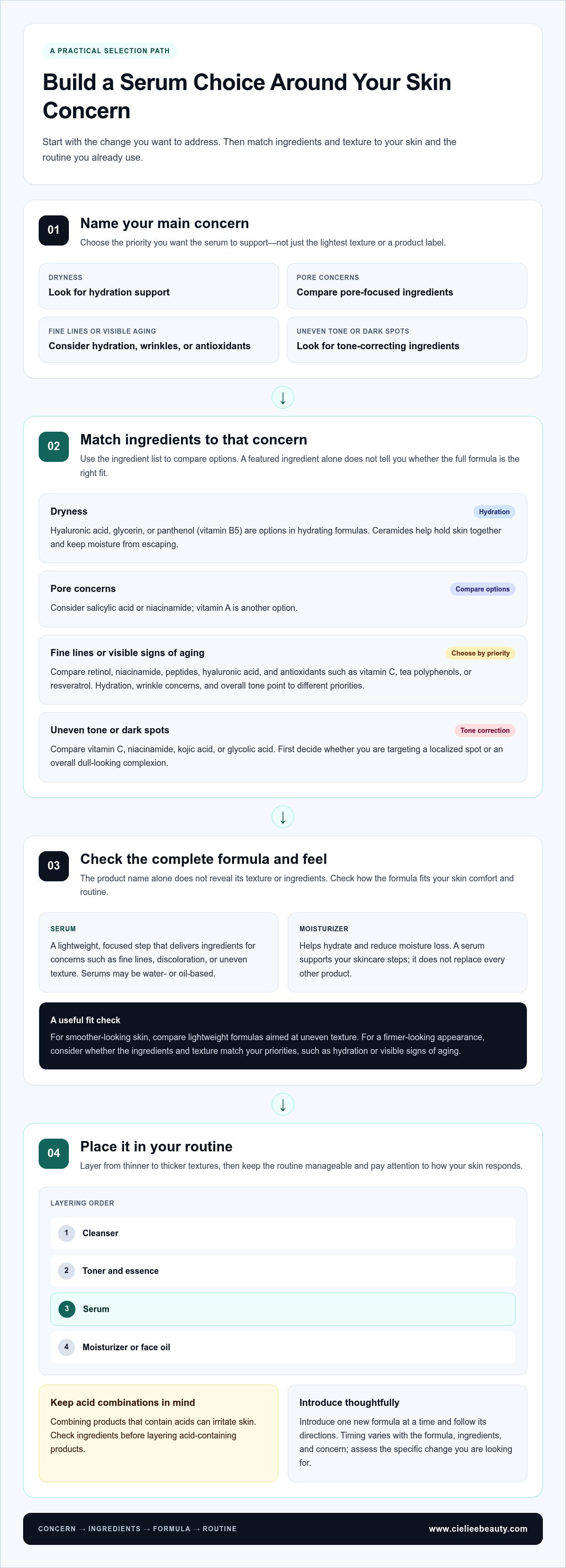
Start with your main concern, then compare ingredients and textures with your skin and routine in mind. A serum should support your skincare steps, not replace every other product.
A face serum is a lightweight product formulated to deliver ingredients for concerns such as fine lines, discoloration, or uneven texture. Unlike a moisturizer, which helps hydrate and reduce moisture loss, a serum focuses on targeted ingredients. Serums may be water- or oil-based, so consider how the finish will fit your routine. Apply one after cleansing and before moisturizer.
Serums for Skin Types and Concerns
For dryness, look for hyaluronic acid, glycerin, or panthenol, also called vitamin B5. Ceramides help hold skin together and keep moisture from escaping. For pore concerns, consider salicylic acid or niacinamide; vitamin A is another option. For fine lines, antioxidant ingredients such as tea polyphenols or resveratrol may suit your goals. Choose by concern and skin comfort, not price alone.
Texture and Firmer-Looking Skin
Texture can help you decide whether a formula fits your routine. If smoother-looking skin is your priority, compare lightweight formulas aimed at uneven texture. For a firmer-looking appearance, consider the ingredient list and whether the formula matches your priorities, such as hydration or visible signs of aging. A product name alone doesn’t reveal its texture or ingredients.
Can you use multiple serums together, and in what order? Yes, but keep the routine simple and layer from thinner to thicker textures. Apply serum after cleanser, toner, and essence, then use moisturizer or face oil. Combining products that contain acids can irritate skin.
How long does it take for serums to show results? Timing varies with the formula, its ingredients, and the concern you’re targeting. Follow the product directions and assess the specific change you’re looking for.
How should serums be stored, and how long do they last? Follow the package’s storage and use instructions. A product’s usable life depends on its formula and packaging, so follow its guidance rather than assuming every bottle lasts the same length of time.
What serum is best for fine lines and aging skin?
Choose a serum by the concern you want to address and the ingredients in its formula, not by the words “anti-aging” on the label. Retinol, hyaluronic acid, peptides, and vitamin C are common ingredients in formulas targeting visible signs of aging. The right fit depends on how the complete formula feels and works with your routine.
Retinol and niacinamide are options in formulas targeting wrinkles, while hyaluronic acid is used in hydrating formulas. Peptides are another ingredient to compare when looking for an anti-aging serum. Rather than choosing based on one featured ingredient, read the full ingredient list and consider the formula’s texture and stability. Performance depends on the active ingredients, formulation, vehicle, and compound stability.
- For hydration: Consider hyaluronic acid, which is used in hydrating serums.
- For wrinkle concerns: Compare retinol, niacinamide, or antioxidant ingredients.
- For a peptide-focused option: Look for peptides in the ingredients list, then assess the full formula.
Antioxidants such as vitamin C can help neutralize free radicals, which can contribute to skin damage and visible signs of aging. Tea polyphenols and resveratrol are other antioxidant options. Choose according to your priority, whether that’s hydration, wrinkles, or overall tone. A serum with several active ingredients isn’t automatically a better fit.
Build a considered routine by introducing one new formula at a time and following its product directions. If retinol is your focus, compare the formula’s other ingredients and texture before adding it alongside products with similar actives. This makes it easier to notice how your skin responds and keep your routine manageable.
For a separate sensory touch, browse fragrance options without treating them as part of your skincare steps.
What does a facial serum do?
A facial serum delivers focused ingredients for concerns such as uneven tone and dark spots. Choose a brightening formula by its ingredients and the change you want to target.
Brightening and Tone-Correcting Ingredients
For dark spots or a dull-looking complexion, compare vitamin C, niacinamide, kojic acid, and glycolic acid. These ingredients appear in tone-correcting formulas, but they don’t all serve the same role. Vitamin C can help prevent brown spots, reverse ultraviolet-ray damage, and stimulate new collagen growth. Kojic acid and glycolic acid are options in formulas intended to brighten dark patches.
Read the ingredient list with your main concern in mind. If uneven tone is your priority, look for a formula featuring tone-correcting ingredients rather than choosing by “brightening” on the label alone. You can also compare antioxidants: vitamin C is an antioxidant, and antioxidant ingredients can help neutralize free radicals that contribute to skin damage.
Brightening Serums and Dark Spots
Brightening serums can target hyperpigmentation, including dark spots, and help improve a dull complexion. First identify whether your main concern is a localized spot or an overall lack of radiance. Then compare the formula’s ingredients with that goal. Vitamin C, niacinamide, kojic acid, and glycolic acid are examples to look for in tone-correcting products.
A revitalizing formula should still fit your routine. Check its ingredients before layering it with other products, especially if it contains glycolic acid or another acid-based ingredient. Using an acid-containing serum with other acid-containing products can irritate skin. Introduce the brightening step thoughtfully, follow the product directions, and keep the routine focused on your chosen concern.
Serum texture compared with moisturizer, toner, and essence
Texture offers a simple way to understand where each skincare layer fits. Serums are typically thinner than moisturizers but thicker than toners or essences. This middle position makes them easy to layer between lighter, more fluid steps and richer creams. The feel varies by product, since serums can be water- or oil-based.
Think of toner and essence as lighter-feeling layers, serum as a more concentrated treatment, and moisturizer as the richer finishing layer. A hydrating serum may add moisture, while moisturizer helps support the skin’s moisture barrier. Depending on your skin, a hydrating serum may sometimes take the place of moisturizer. Let the product texture and how your skin feels guide that choice.
- Toner: Usually the lightest-feeling step in this comparison.
- Essence: Also typically thinner than serum, making it an earlier layer.
- Serum: A lightweight treatment, often more substantial in feel than toner or essence.
- Moisturizer: Typically thicker than serum and helps reduce moisture loss.
For a smooth layering sequence, apply products from lighter to richer textures. Use toner and essence first, then pat serum onto damp skin. Finish with moisturizer or face oil. A few drops of serum are typically enough for the whole face. Let each layer settle before applying the next, especially if the products start to feel tacky or heavy together.
Use texture as a practical filter, not as a measure of strength. For example, a watery serum may suit a routine that already includes a rich moisturizer, while an oil-based serum can feel more substantial. Check the formula’s ingredients and directions too. If you’re ready to explore scent as a separate self-care detail, browse fragrance options.
CIELIEE BEAUTY: 100/120pcs Pink White Press On Nails Medium Trapezoid Acrylic False Nails Full Artificial Fingernails Extension Fake Nail Tips
CIELIEE BEAUTY offers a face serum for readers looking to explore a skincare option after comparing ingredients and routine fit. The 100ml 24k Gold Hyaluronic Acid Nicotinamide Face Serum Anti Aging Facial Lifting Collagen Essence Skin Care Whitening Serum combines several ingredients named in its product title, including hyaluronic acid and nicotinamide. Consider it as one option to review against your priorities, such as hydration or uneven tone, and the ingredients your routine already includes.
CIELIEE BEAUTY’s beauty selection also includes press-on nails, mirror lip gloss, and lip oil. These are separate choices, not substitutes for a face serum. Explore CIELIEE BEAUTY’s skincare and beauty products on the site.
Make Your Routine Feel Like Your Own
Keep your skincare routine responsive rather than fixed. As your priorities change, revisit the ingredients you choose and whether each layer still feels comfortable. To keep serums purposeful, introduce one formula at a time and notice how it fits with the rest of your routine. Keep the steps that serve your needs and leave out anything that feels unnecessary.
Self-care can also reach beyond skincare. Fragrance is a separate sensory detail, not another layer in your face routine. If you’d like to explore that side of a daily ritual, browse fragrance options and choose a scent that feels like you. Take your next step at your own pace, with a routine that feels considered and easy to return to.
Frequently Asked Questions
Are all skin serums created equal?
No. Formulas differ in their active ingredients, base, and stability, which can affect how they fit your routine. For example, two products marketed for fine lines may take different approaches, such as hydration or antioxidants. Compare the full ingredient lists and choose according to your main concern. A higher price alone doesn’t show that one formula will work better for you.
Can serums cause breakouts?
A breakout or irritation may occur after introducing a new serum, but that doesn’t mean every formula will cause one. Powerful ingredients can irritate sensitive skin. Try a small area first, introduce one new product at a time, and follow its directions. This makes it easier to identify which product may be contributing to a reaction.
What serum should I use for dark spots and uneven skin tone?
Look for a tone-correcting formula with ingredients such as vitamin C, niacinamide, kojic acid, or glycolic acid. Then narrow your choice by checking the full ingredient list and avoiding a routine that combines several acid-containing products. For example, if your routine already includes an acid product, choose a different approach rather than layering on another acid serum.
When should I apply serum in my skincare routine?
Apply serum after cleansing and any toner or essence, then follow with moisturizer or face oil. If you use both toner and essence, apply them before the serum to keep the order clear. Follow each product’s directions and keep the sequence consistent, so you can tell whether a new step feels comfortable alongside your usual skincare.
Which vitamin C serum should I use?
Choose a vitamin C formula that matches your goal, such as addressing dullness or uneven tone, and review its full ingredient list. Formula stability and overall composition can affect performance, so the ingredient name alone doesn’t settle the choice. If you’re introducing vitamin C, add it as a distinct new step rather than changing several products at once.
What are serums and what are they used for?
Serums are lightweight topical treatments formulated to deliver ingredients for targeted concerns. A hydrating formula may support moisture, while a tone-focused option may address dark spots or dullness. Other formulas target uneven texture or visible fine lines. Think of a serum as a focused addition to your skincare routine, then choose one based on the concern you want to prioritize.